
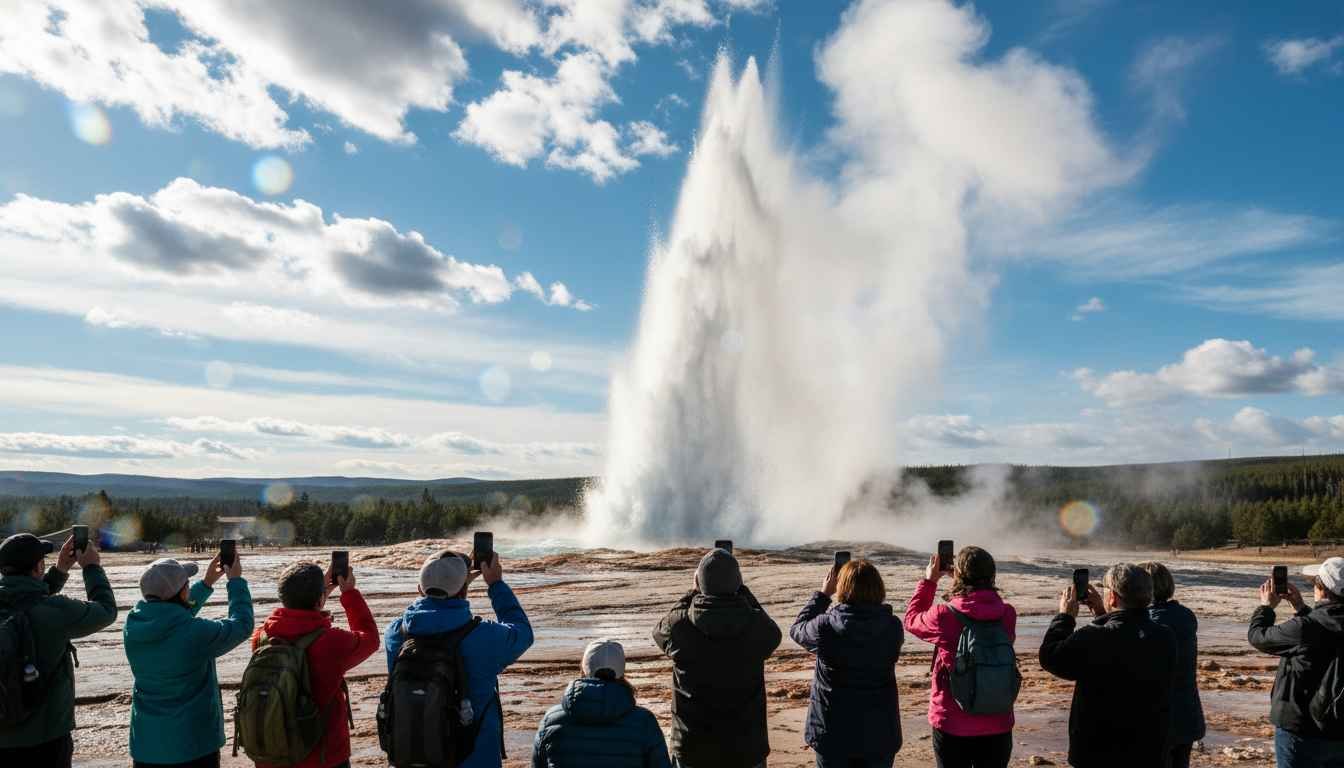
Dawn in the Lamar Valley. Mist hangs over the river, and a herd of bison drifts across the meadow like slow ships while a wolf pack — just dark shapes at this distance — works the far tree line. An hour later you will be standing in a crowd watching boiling water shoot 150 feet into the air. By afternoon, you could be staring into a canyon twice as deep as you expected. That is Yellowstone: the world’s first national park, still the strangest and most spectacular two million acres in America.
First-timers often ask what the best places to visit in Yellowstone actually are, because the park is enormous and a wrong turn can cost you hours. This guide covers the essential stops, organized the way you should see them.
Old Faithful and the Upper Geyser Basin
Start with the icon. Old Faithful erupts roughly every 60 to 110 minutes, shooting thousands of gallons of boiling water up to 180 feet high — and the visitor center posts predicted eruption times, so you can plan around it rather than waiting blindly. Arrive 20 minutes early for a good spot on the boardwalk benches.
Do not leave after the eruption. The Upper Geyser Basin holds the greatest concentration of geysers on Earth, and the boardwalk loop passes showstoppers like Grand Geyser (the tallest predictable geyser in the world) and the brilliantly colored Morning Glory Pool. Give this area at least half a day.
Grand Prismatic Spring and Midway Geyser Basin
If you have seen one photo of Yellowstone, it was probably Grand Prismatic Spring — the rainbow-ringed hot spring larger than a football field, colored by heat-loving microbes in bands of orange, gold, and deep blue. The colors are most vivid in summer, and the overlook from the Fairy Falls trailhead gives you the elevated view that makes the photos famous. Go early: the parking lot fills by mid-morning in peak season, and the steam is thickest (and most photogenic) in cool morning air.
Lamar Valley: Wildlife Watching
Often called the “Serengeti of North America,” the Lamar Valley in the park’s northeast is the best place in Yellowstone to see wildlife. Dawn and dusk are prime time: bison herds, elk, pronghorn, grizzly bears, and the park’s famous wolf packs. Bring binoculars or a spotting scope — the serious wildlife watchers set up along the pullouts with scopes that will happily be shared if you ask politely.
Stay in your vehicle near bears and wolves, keep the legally required distance from all wildlife (100 yards from bears and wolves, 25 from everything else), and never approach a bison. They look slow. They are not.
Grand Canyon of the Yellowstone
The Yellowstone River has carved a canyon 20 miles long and up to 1,200 feet deep, and the viewpoints along its rims are staggering. Artist Point on the south rim frames the 308-foot Lower Falls with the yellow-hued canyon walls — the single most painted and photographed view in the park. Lookout Point and the Brink of the Lower Falls trail on the north rim get you closer to the thunder of the water. The short Uncle Tom’s Trail descent (steep, with switchbacks) rewards the effort with a face-full of mist.
Yellowstone Lake and the Lake Area
At 7,733 feet above sea level, Yellowstone Lake is one of the largest high-elevation lakes in North America. The shoreline near Fishing Bridge and the Lake Village area offers easy walks, the historic Lake Yellowstone Hotel (worth a look even if you are not staying), and in summer, fishing and boating. The West Thumb Geyser Basin on the lake’s western shore pairs steaming pools with lakeside views — geysers erupting at the water’s edge is a combination you will not see anywhere else.
Hiking: Trails Worth Your Time
You do not need to be a backpacker to get beyond the boardwalks. A few standout day hikes:
- Mount Washburn Trail: a 6-mile round trip to a fire lookout with panoramic views across the entire park — bighorn sheep frequent the slopes.
- Fairy Falls Trail: a gentle 5-mile round trip to a 200-foot waterfall, passing the Grand Prismatic overlook on the way.
- Mystic Falls: a short, family-friendly loop behind Biscuit Basin to a 70-foot cascade most visitors miss.
Carry bear spray on every hike, make noise on blind corners, and check trail conditions at a visitor center — snow can linger on high trails into July.
Planning Tips
When to go: summer (July–August) offers full access to all roads and services but also the biggest crowds. Late May–June and September bring fewer people, active wildlife, and mostly open roads, with cooler weather as the trade-off. Much of the park closes to cars from November through April.
Book lodging early. In-park lodges and campgrounds fill months ahead for summer — reservations open far in advance and the best spots go fast. Gateway towns like West Yellowstone and Gardiner offer more options.
Add Grand Teton. Just south of Yellowstone, Grand Teton National Park’s jagged peaks and alpine lakes make a natural add-on. The drive between the parks via the John D. Rockefeller Jr. Memorial Parkway is spectacular in itself — budget at least a day.
FAQ
How many days do you need in Yellowstone?
Three full days covers the highlights: one for the geyser basins, one for the canyon and lake areas, and one for Lamar Valley wildlife. Four to five days lets you add real hikes and a Grand Teton side trip without rushing.
What is the best time to see wildlife in Yellowstone?
Dawn and dusk, in the Lamar and Hayden Valleys. Spring brings newborn animals and hungry bears; fall brings the elk rut. Summer wildlife viewing is still excellent if you go early.
Is Yellowstone good for kids?
Very. Boardwalk geyser basins, the Junior Ranger program, easy waterfall trails, and constant wildlife sightings keep kids engaged. Just keep them close on boardwalks and well away from thermal features — the ground near hot springs can be dangerously thin.
Do I need bear spray?
Yes for any hiking. Carry it accessible (not in your pack), know how to use it, and check current bear activity reports at visitor centers.
Final Thoughts
Yellowstone rewards the traveler who slows down. The checklist — Old Faithful, Grand Prismatic, the canyon, the valley — matters, but the park’s real gift is the unplanned moment: a bison blocking the road at sunset, steam rising off a river at dawn, the silence of a high trail. See the famous places, absolutely. Then linger. Two million acres of the strangest, wildest landscape in America deserves more than a drive-through.