
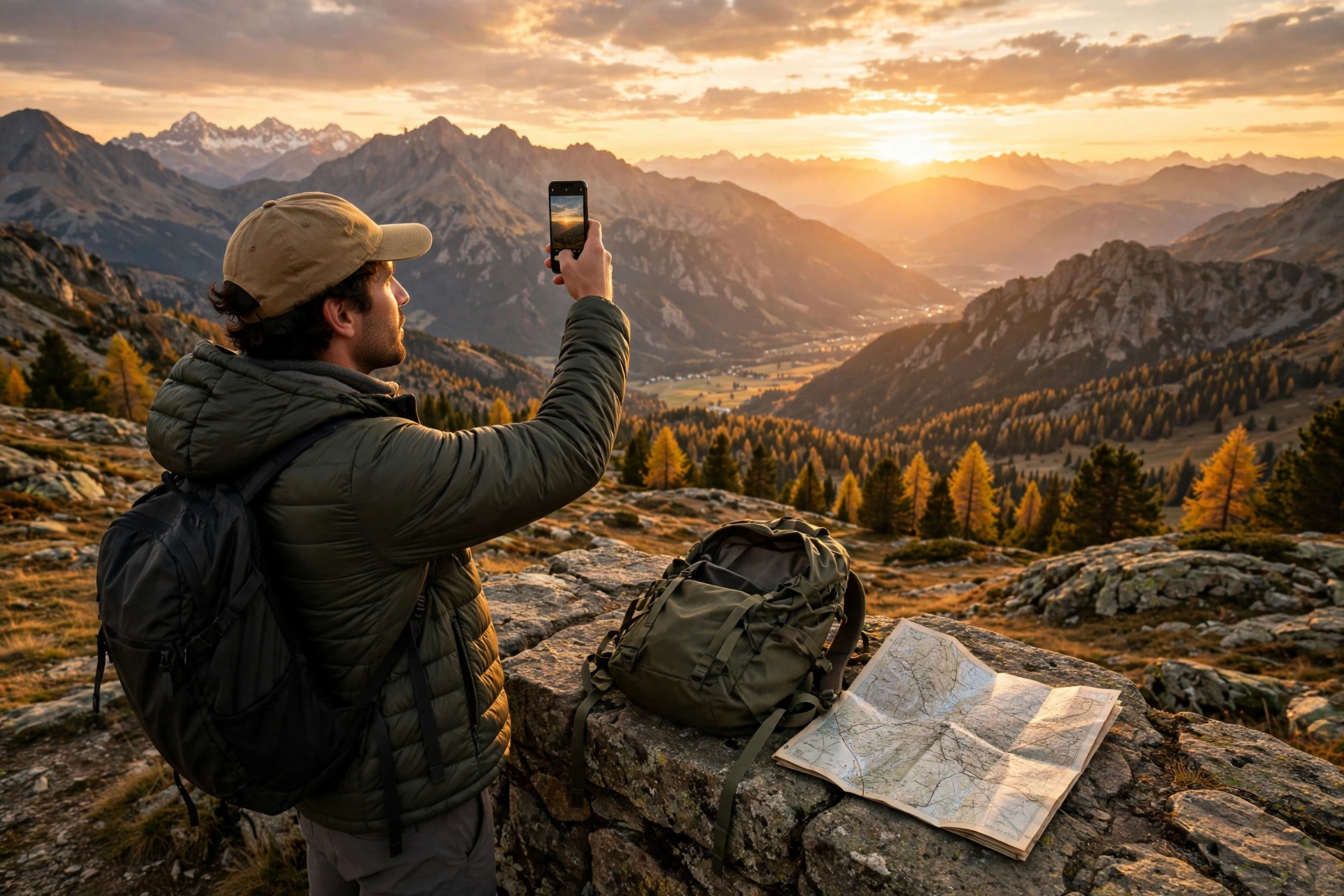
You are standing at the edge of a viewpoint you may never visit again, the light is perfect, and the only camera you have is the phone in your pocket. That is enough. Modern phones take photographs good enough to print and frame — but only if you use them with a little intention. This guide shows you how to photograph your travels with a phone, from the settings worth changing before you leave to the small habits that turn quick snapshots into pictures you will actually want to keep.
Start With the Camera You Already Know
Before your trip, spend ten minutes with the camera app you already have. Open it, tap through the modes, and learn where the useful controls live: the grid, the exposure slider, the zoom levels, and the portrait and night modes. Every phone hides these in slightly different places, and the worst time to discover them is while a sunset is fading. If you use an iPhone, Apple’s own guide to taking great photos and videos explains each mode in plain language.
Turn on the grid lines. The grid divides your screen into nine equal parts and makes it easy to place your subject off-centre, which almost always looks better than dead centre. Turn on the option that saves a normal photo alongside any HDR or live version, so you always have a clean file to work with later. And check your storage: a week of travel photos and short videos fills a phone faster than most people expect, so free up space or set up cloud backup before you leave home.
Clean the Lens and Check Your Settings
A phone lens spends its life in pockets, bags, and hands, and a smudged lens is the most common reason travel photos look hazy. Wipe the lens with a soft cloth — a shirt hem works in a pinch — every time you take the phone out for an important shot.
Use Natural Light to Your Advantage
Light matters more than any camera setting. The hour after sunrise and the hour before sunset — the golden hours — give you warm, soft light that makes almost any scene look good. Midday sun creates harsh shadows and washed-out colours, so when the sun is high, look for shade or turn your attention to details, food, and interiors instead of wide landscapes.
When you photograph a person against a bright sky or window, tap on their face on the screen before you shoot. That tells the phone to expose for the face instead of the bright background, so the person is not left as a dark silhouette. If the scene is still too bright or too dark, slide your finger up or down after tapping to focus — that small exposure adjustment is the most useful control on any phone camera. For night scenes, hold the phone steady with both hands or rest it on a table; night mode does the rest, but it cannot fix a shaky hand.
Compose the Shot Before You Tap
Good travel photos are composed, not just captured. Before you press the shutter, take three seconds to look at the frame. Move your feet instead of pinching to zoom — stepping closer almost always gives a stronger image than digital zoom, which simply crops and softens the picture. Use your phone’s optical zoom steps (1x, 2x, 3x) rather than sliding to an in-between value.
Put something in the foreground. A railing, a doorway, or a branch gives the viewer a sense of place and depth that a flat view of a mountain cannot. Look for leading lines — a road, a river, a row of columns — that pull the eye toward your subject. And shoot both orientations: vertical suits a tall building or a portrait, horizontal suits a landscape or a group. You cannot reframe a vertical shot into a wide one later, so take both when the scene deserves it.
Photograph People and Places Honestly
The best travel photos show what a place actually felt like. Photograph the ordinary things as well as the famous ones: the breakfast table, the crowded metro, the shopkeeper arranging fruit. These small frames are the ones that bring a trip back to life months later.
When people are in your frame, be respectful. Ask before photographing someone up close, especially children, and accept a no gracefully. In markets, temples, and ceremonies, watch what local people do first — if nobody else is taking photos, put your phone away.
Plan Photo Stops Into Your Day
Great travel photos rarely happen by accident; they happen because you were in the right place at the right time. When you plan your day, note one or two spots worth visiting at golden hour and build the rest of the day around them. If you are driving between places, it helps to plan a road trip itinerary with multiple stops so that viewpoints, towns, and photo breaks are part of the route instead of rushed afterthoughts. Arrive a little early and take your time — five unhurried minutes at one viewpoint beats twenty hurried snapshots at five.
Make the Most of a Short Stop
Not every trip gives you a full day at a location. A long layover or a few free hours in a new city can still produce wonderful photos if you keep it simple: pick one neighbourhood, walk it slowly, and photograph what catches your eye instead of racing between landmarks. If you want a plan for squeezing a city into a few hours, this guide on how to plan a layover tour in a new city shows how to structure a short visit. On a short stop, shoot fewer photos and look longer — ten thoughtful frames beat a hundred rushed ones.
Edit Lightly on Your Phone
Editing is where good travel photos become great ones, and your phone already has everything you need. Start with the basics: straighten a tilted horizon, crop out a distracting edge, then adjust brightness and warmth in small steps. The auto-enhance button is a reasonable starting point, but pull it back a little — fully automatic edits often oversaturate colours.
Keep your edits consistent. A similar touch across the whole trip makes your album feel like one story instead of a random collection. Avoid heavy filters that stamp the same look on every image; a filter that flatters a beach sunset will usually ruin a forest path. Edit the photos you love and leave the rest alone.
Back Up Your Photos Every Night
A phone can be lost, stolen, or dropped in water, and a trip’s photos are the one thing you cannot replace. Back up every night over the hotel Wi-Fi, whether that means a cloud service or a small portable drive. Delete the obvious failures — the blurry shots, the accidental pocket photos — as you go, so your backup is a clean set of keepers rather than thousands of duplicates.
FAQ:
Do I need a separate camera app to take good travel photos?
No. The built-in camera app on a modern phone handles almost everything a traveller needs. Third-party apps are only useful if you want manual control over shutter speed and ISO, for example for night photography.
Should I shoot in portrait or landscape orientation?
It depends on the subject. Use portrait orientation for tall subjects and people, and landscape for wide views and groups. When in doubt, take both — storage is cheap and the moment is not repeatable.
How many photos should I take each day while travelling?
There is no right number. Aim for quality over quantity: a hundred thoughtful photos from a day of sightseeing are more useful than a thousand rushed ones.
Is it safe to use my phone camera in crowded places?
Generally yes, but stay aware of your surroundings. Keep a firm grip, use a wrist strap or a cross-body phone lanyard in busy markets and stations, and avoid waving an expensive phone around where pickpocketing is common.
Final Thoughts
You do not need expensive gear to bring home beautiful travel photographs — you need a clean lens, good light, a few seconds of thought before each shot, and the habit of backing up every night. The difference between an ordinary snapshot and a photo you will treasure is rarely the device. It is the patience to wait for the light, the care to frame the scene, and the willingness to look a little longer before you tap.