
You have probably bought a beautiful notebook, written in it for three days, and then watched it gather dust on a shelf. That is not a failure of willpower — it is a failure of setup. A daily journaling habit does not need long entries or deep thoughts every morning. It needs a small, repeatable routine that fits into a day you already live. This guide shows you how to start a daily journaling habit as a beginner, from choosing your journal to keeping it alive.
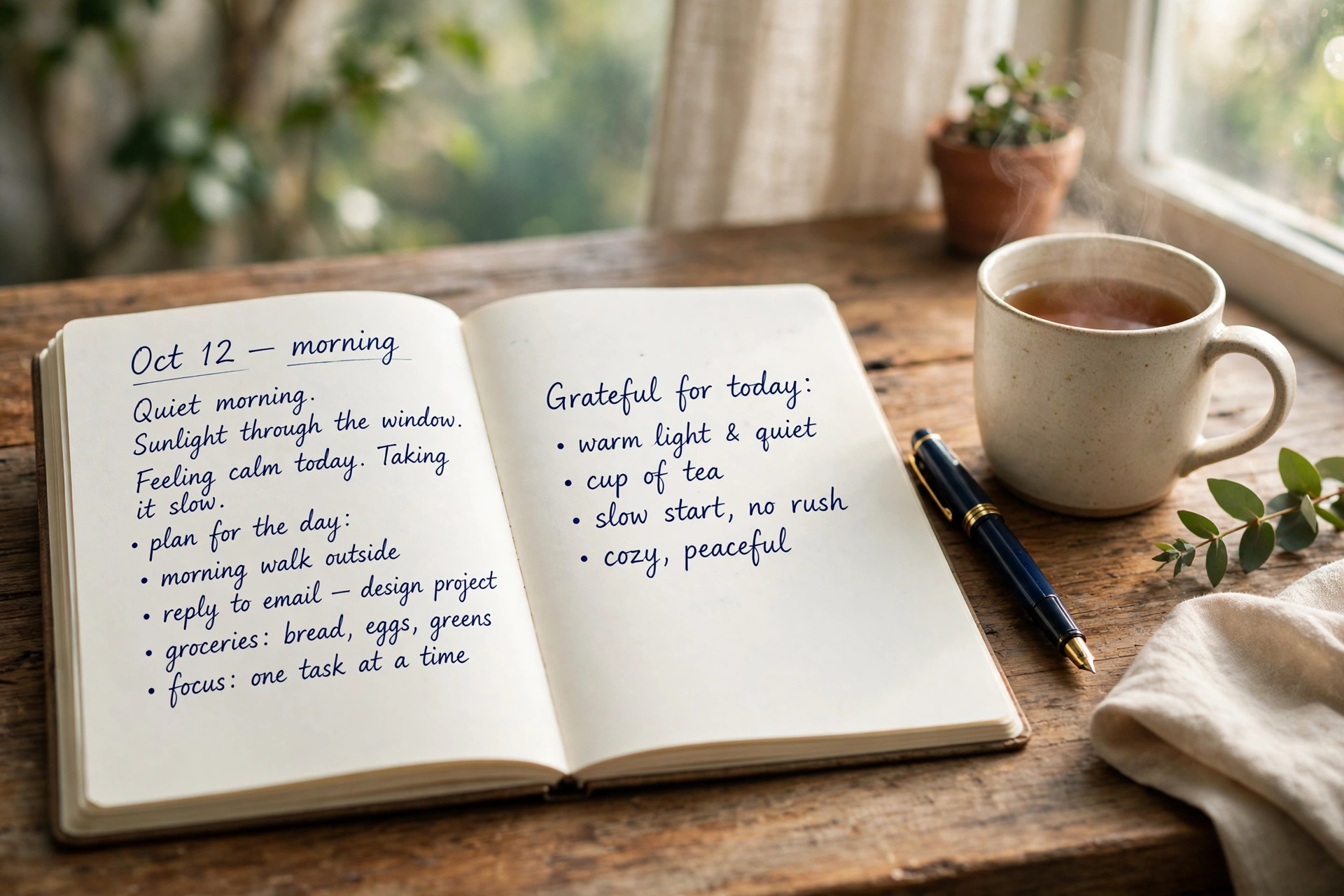
Why a Daily Journaling Habit Is Worth Starting
Journaling gives your thoughts somewhere to land. During the day, ideas, worries, and half-finished plans swirl around in your head, and writing them down slows your thinking just enough to see them clearly. That clarity is the real benefit — not beautiful prose.
A daily habit also creates a record you can look back on. A few lines a day add up to an honest picture of your life — what you worried about, what you enjoyed, what kept repeating — and many people find it helps them notice patterns, like the same worry appearing every Sunday evening.
Pick a Journal You Will Actually Use
The best journal is the one you will open tomorrow. Beginners often choose the impressive option instead of the practical one: a thick leather-bound book they are afraid to spoil, or an app with so many features that opening it feels like work.
A plain paper notebook has one big advantage — no notifications, no battery, no distractions. A notes app is always with you and everything is searchable. Either one works, so choose the one you already reach for. If you like writing by hand, a cheap notebook you are not afraid to mess up beats an expensive one you keep saving for the “right” entry.
Keep the journal somewhere visible, not in a drawer — a notebook on your pillow or next to the coffee maker removes the one obstacle that kills most habits: forgetting. If you also use your notebook while travelling, you can organize your travel notes and itineraries in one notebook so everything lives in a single place.
Choose a Time and Anchor It to Something You Already Do
A habit sticks when it attaches to something you already do every day. Pick a moment that is already fixed in your routine — morning coffee, the train ride, or the ten minutes before bed — and put journaling right after it. The specific time matters far less than the pairing.
Mornings suit setting intentions for the day; evenings suit unloading the day before bed. If you are not sure, try each for a week and keep whichever one you actually did. A routine you follow beats a theoretically perfect routine you skip.
Set a gentle reminder for the first two weeks only — a phone alarm or a sticky note. After that, the anchor itself should do the reminding. If you miss the moment, write at the next quiet gap instead of waiting for tomorrow.
Start Small: Five Minutes Is Enough
The most common beginner mistake is aiming too high. A page a day sounds reasonable until life gets busy, and then the blank page becomes a reason to skip entirely. Five minutes is enough — set a timer if it helps, and stop when it rings.
Give yourself permission to write badly. Spelling, grammar, and neat handwriting do not matter — nobody is grading this. A single honest sentence counts as a day done: “Tired today. The meeting went better than I feared.” That is a complete entry.
What to Write When You Don’t Know What to Write
Staring at a blank page is the second most common reason beginners quit. Prompts fix that — pick one question, answer it honestly, and stop when you are done:
- What happened today that I want to remember?
- What am I worried about, and what is the next small step I can take?
- What went well today, even in a small way?
- What is one thing I keep avoiding, and why?
You do not need to answer all of them — one is enough. Over time you will notice which questions you return to, and those are the ones that matter.
Your journal can also hold practical plans, not just feelings. When a trip idea pops up, you can plan a road trip itinerary with multiple stops right in your journal before you book anything, and the notes will still be there when you need them.
Try a Simple Journaling Method
There is no single correct way to journal. Try one method for a week before judging it — four beginner-friendly options cover most needs.
Freewriting. Write whatever comes to mind without stopping or editing — messy, honest, and fast, good for clearing a crowded head.
Gratitude list. Write down three things that went well today. Specific beats grand: a good lunch counts more than a vague “my health.”
Bullet journaling. Short lines with simple markers — a dot for a task, a dash for a note, a circle for an event. Good if you like structure and want your journal to double as a planner.
One line a day. A single sentence per day. This is the lowest-pressure method there is, and it is perfect for busy weeks.
How to Stay Consistent When Motivation Fades
Motivation always fades — usually around week two or three. That is normal, and it is where the habit is actually built.
First, track your days visibly. A simple calendar with a tick for each day you wrote turns the habit into something you can see — the goal is a calendar that is mostly full, not a perfect streak.
Second, lower the bar instead of raising it. On a hard day, write one line. The rule that keeps habits alive is simple: never miss twice — one missed day is an accident, but two in a row is the start of quitting.
Third, review your entries once a week. Five minutes on a Sunday, flipping back through the week, reminds you why you are doing this and shows you patterns you missed while writing.
Mistakes That Quietly Kill a New Journaling Habit
Writing only when inspired is the biggest one. Inspiration is unreliable, and waiting for it turns journaling into something you do twice a month. Write on ordinary days too — they are most of your life, and they deserve a record.
Chasing perfect entries is another. If every entry has to be insightful, you will avoid writing on days when you have nothing profound to say. A boring entry still keeps the habit alive for the days when something worth writing does happen.
Buying supplies instead of writing is a quieter trap. A new pen or a prettier notebook feels like progress, but it is not — use what you have, and let the habit earn the upgrade.
Finally, do not compare your journal to anyone else’s. The neat, illustrated pages you see online are a hobby in themselves. Your journal only has to work for you.
FAQ:
How long should a journal entry be?
As long as it needs to be — one honest sentence counts, and five minutes is a complete session.
Is it better to journal in the morning or at night?
Whichever time you will actually do it. Mornings suit planning and clearing your head; evenings suit reflection. Try both for a week each and keep the one that sticks.
Do I need a special notebook or app?
No. A cheap notebook or the notes app already on your phone is enough. Choose the tool you will open tomorrow, not the one that looks best on a shelf.
What if I miss a day?
Nothing happens — write the next day. A missed day only becomes a problem when it turns into a missed week, so the only rule is: never miss twice.
Final Thoughts
Starting a daily journaling habit is not about discipline or talent. It is about setup: a journal you will actually open, a time anchored to something you already do, and a bar low enough to clear on your worst day. Five minutes and one honest sentence — that is the whole system. Begin tonight or tomorrow morning and keep it small. A year from now, you will have a record of your life that no one else could have written for you.