
You walk through a Roman gate that has stood for nearly two thousand years, climb a medieval castle staircase worn smooth by centuries of feet, and stand before a wall that divided a city within living memory — all in one country, sometimes in a single week. Germany’s history is not confined to museums: it is built into its towns, castles, and city streets. This guide covers the best historical places to visit in Germany, from Roman ruins and medieval castles to the memorials of the Second World War and the Cold War.
Medieval Castles and Fortresses
Germany’s castles are the stuff of postcards, and the most famous is Neuschwanstein Castle in Bavaria, built in the 19th century by King Ludwig II of Bavaria as a romantic retreat. Its fairy-tale towers, set against the Alps, are said to have inspired Disney’s castle designs, and it draws well over a million visitors a year — book timed tickets ahead. For a quieter, more genuinely medieval experience, visit Burg Eltz, a 12th-century castle in the Moselle Valley that has remained in the same family for centuries, or Hohenzollern Castle in Baden-Württemberg, perched dramatically on a hilltop. Together they show two sides of German castle history: romantic fantasy and real feudal power.
Roman Germany: Trier, Cologne, and Xanten
Long before the castles, Rome ruled much of western Germany, and the evidence is still standing. Trier, Germany’s oldest city, holds the Porta Nigra, a massive Roman city gate dating from around the 2nd century AD, along with an amphitheatre, imperial baths, and the Aula Palatina, a Roman basilica now used as a church. In Cologne, the Roman-Germanic Museum and the remains of the Praetorium, the Roman governor’s palace, sit beside the great Gothic cathedral, layering two thousand years of history in one square. For a full Roman town experience, the Archaeological Park Xanten reconstructs a Roman city on its original site, with an amphitheatre, baths, and a museum — one of the best family-friendly Roman sites in the country.
Second World War and Cold War Landmarks
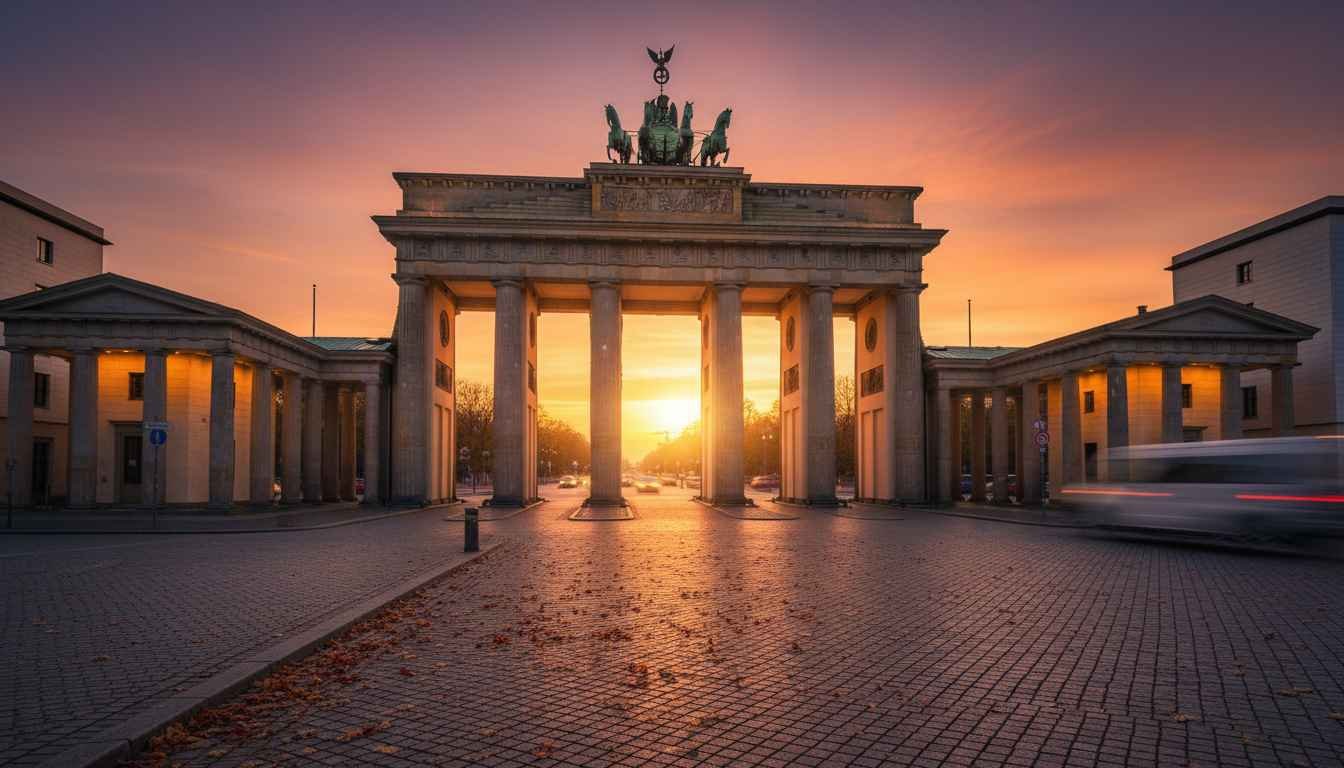
Germany’s 20th-century history is preserved with unusual frankness, and its memorials are essential, sobering visits. In Berlin, the Memorial to the Murdered Jews of Europe, a field of 2,711 concrete slabs near the Brandenburg Gate, and the Topography of Terror documentation centre, on the site of the former Gestapo headquarters, confront the Nazi era directly. The Dachau Concentration Camp Memorial Site, near Munich, and Sachsenhausen, near Berlin, are preserved camps that now serve as memorials and museums; allow a full half-day, go with older children only, and expect an emotionally difficult visit. Berlin’s Cold War history is equally visible: the East Side Gallery, a surviving stretch of the Berlin Wall painted by artists after 1989, and Checkpoint Charlie, the former Allied crossing point, mark a division that ended within living memory.
Historic Towns and Villages
Beyond the great monuments, Germany’s historic towns are where the past feels lived-in. Rothenburg ob der Tauber, on the Romantic Road in Bavaria, keeps its medieval walls, gates, and half-timbered houses almost intact, and walking the wall at dusk is the town at its best. Heidelberg, with its ruined castle above the Neckar River and Germany’s oldest university, founded in 1386, mixes student life with romantic old-town streets. Lübeck, the former Hanseatic port on the Baltic, and Bamberg, with its old town hall built on an island in the river, are UNESCO-listed alternatives that reward travellers who venture beyond the famous names. Another historic European city break is covered in the top ten places to visit in Vienna.
Planning a Historical Trip to Germany
Spring and autumn are the best seasons for historical sightseeing: mild weather, fewer crowds than summer, and comfortable walking in old towns. Base yourself in one region per trip — Bavaria for castles, the Rhineland for Roman sites, or Berlin for 20th-century history — rather than trying to cover the whole country at once, and travel between towns by train, which is fast and reliable. Many castles and memorials require timed tickets or guided tours, so book ahead in high season, wear comfortable shoes for cobblestones and castle steps, and check opening days: some smaller museums close on Mondays.
FAQ
What is the most famous historical place in Germany? Neuschwanstein Castle is the most visited, but for historical depth, Trier’s Roman monuments and Berlin’s memorials are at least as important.
How many days do you need for Germany’s historical sites? A single region needs three to four days; a trip combining Bavaria, the Rhineland, and Berlin needs at least ten days to avoid rushing.
Are Germany’s historical sites suitable for children? Castles, Roman parks such as Xanten, and old towns are excellent for children, while concentration camp memorials are best for teenagers and adults, with preparation beforehand.
Final Thoughts
Germany’s historical places tell a long, complicated story — Roman engineers, medieval kings, romantic dreamers, and the darkest chapters of the 20th century, all within a few hours’ train ride. Visit with curiosity and with respect for the memorials, and you will come away with a far deeper understanding of Europe than any single castle or museum could give you alone.