
Picture yourself standing in a quiet room where a violent crime has just been reconstructed from drops of blood on a wall. You measure the stains, work out the angles, and slowly the sequence of events comes into focus: where the victim stood, how many blows were struck, which direction the attacker moved. That is the work of bloodstain pattern analysis — and the training behind it is far more structured, and far more honest, than television makes it look.
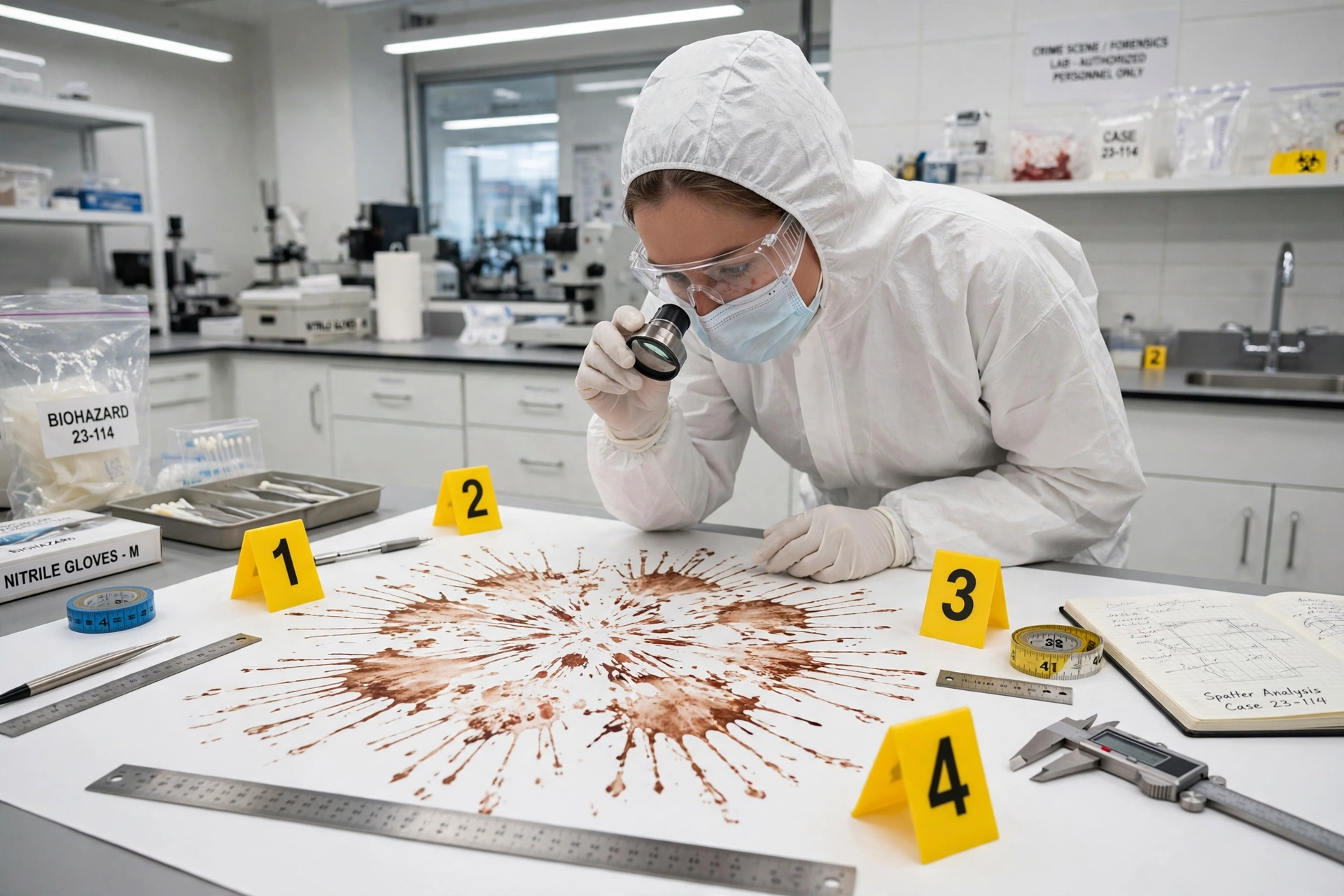
Blood spatter analyst education is the path into that work. It is not a single degree, and it is not a quick course that makes you an expert. It is a combination of science education, specialist training and supervised experience, built around a professional standard set by the International Association of Bloodstain Pattern Analysts (IABPA). This guide explains what the training actually involves, what it costs in time, and what the career really looks like.
What a Blood Spatter Analyst Actually Does
Bloodstain pattern analysis, usually shortened to BPA, is the study of the size, shape and distribution of bloodstains to work out what happened at a scene. Analysts look at patterns — passive drops from a bleeding wound, transfer stains left when a bloody object touches a surface, projected patterns from impact, and arterial spurts — and use them to test a version of events.
A pattern can suggest the direction blood travelled, the approximate position of the victim, the type of force involved and sometimes the number of blows. It cannot do what television suggests: it cannot identify a weapon from a stain alone, prove intent, or reconstruct a scene with certainty. A good analyst states what the patterns support and what they do not, and says so in court.
One fact matters for anyone considering this career: “blood spatter analyst” is rarely a standalone job title. Most analysts are crime scene investigators or forensic scientists first, and BPA is a specialism they add to that role. You are hired to process crime scenes; the bloodstain work is part of it.
Step One: A Science Degree
Almost every route into forensic work starts with a bachelor’s degree. Forensic science is the obvious choice, but biology, chemistry, physics and other laboratory sciences are all accepted routes — what matters is a solid grounding in the sciences, especially biology and chemistry, plus the maths and statistics that pattern analysis depends on.
A forensic science degree is helpful but not strictly required for this specialism. Many working analysts entered with a general science degree and added forensic training afterwards. What employers look for is evidence you can do careful laboratory work, document it properly and explain it plainly — skills that are tested long before you ever look at a bloodstain.
Step Two: The 40-Hour Basic BPA Course
The specialist training starts with a basic bloodstain pattern analysis course. The IABPA publishes guidelines for what such a course must contain, and approved courses run for a minimum of forty hours, usually over one working week. The IABPA’s own course guidance is blunt about expectations: the content of a basic course “is not intended to create an ‘instant’ expert.”
A basic course covers the physics of how blood behaves, the physiology behind it, and the standard pattern taxonomy — the SWGSTAIN terminology that analysts use worldwide to describe patterns consistently. Students learn to measure stains, calculate angles of impact, work out areas of origin, and document a scene with photographs and diagrams. Practical sessions use blood substitutes and staged scenes, so students practise on realistic patterns before they ever touch a real case.
Approved courses are offered by forensic training providers and universities, and by bodies such as Texas A&M’s TEEX forensic academy, whose 40-hour Bloodstain Pattern Analysis course is open to law enforcement and crime scene personnel. Completing an IABPA-approved basic course also makes you eligible to apply for IABPA membership.
Step Three: Certification and Professional Standards
After the basic course, analysts can work towards certification. The International Association for Identification (IAI) offers a Bloodstain Pattern Analyst Certification, which requires documented training and experience and is renewed with further training hours. There is no single national licence for this work in the United States; certification is voluntary, but it is how employers and courts judge whether an analyst meets the professional standard.
Advanced courses follow the same 40-hour format and cover harder problems: patterns on fabrics, high-velocity impact spatter, and complex scenes with overlapping patterns. Analysts are expected to keep learning throughout their careers, through workshops, conferences and case review with peers.
Skills That Matter Beyond the Course
The course teaches the science. The job demands more. Analysts must photograph and document a scene so thoroughly that someone else could follow their reasoning months later. They must write reports a jury can understand, and defend them under cross-examination. They must work with police, pathologists and lawyers without taking sides — an analyst’s job is to report what the evidence shows, not to help one side win.
Courts also test the science itself. In the United States, expert evidence must meet reliability standards — the Daubert standard in federal courts — which means an analyst’s methods must be testable, peer-reviewed and applied consistently. That is one more reason the training is standardised: sloppy methods do not survive a courtroom.
What the Career Actually Looks Like
Most bloodstain analysts work for police departments, state crime laboratories or medical examiner offices, as part of a crime scene or forensic science unit. Some work for private forensic firms, on insurance cases or independent investigations. The work is irregular — scenes do not keep office hours — and it is demanding in ways that have nothing to do with science: it means working around violent death, staying calm under pressure, and being precise when everyone else is in a hurry.
Pay varies widely by agency, location and seniority, and there is no reliable single figure to quote — check current job postings from the agencies you would actually apply to. Competition for forensic posts is real, and a BPA specialism helps, but it does not replace the degree and the crime scene experience that employers ask for first.
How to Start: A Practical Checklist
If this is the career you want, the order of operations is straightforward. First, earn a science degree, choosing biology or chemistry modules where you can. Second, get crime scene or laboratory experience — many analysts start as crime scene technicians, evidence technicians or laboratory assistants. Third, take an IABPA-approved 40-hour basic BPA course once you are working in the field, since most courses are designed for people already in forensic or law enforcement roles. Fourth, join the IABPA, keep records of every case and course, and work towards IAI certification. And keep reading the research: the terminology and the methods are still being refined, and the analysts who stay current are the ones courts trust.
If you are still weighing up degree options, our guide to finance vs marketing degrees shows how to compare two very different career paths on evidence rather than hype — the same approach works for choosing a science route.
FAQ
Do I need a degree to become a blood spatter analyst?
In practice, yes — employers hiring forensic scientists and crime scene investigators expect a bachelor’s degree in forensic science or a related science, and the specialist BPA course builds on that, rather than replacing it.
How long does the training take?
The basic BPA course is a minimum of forty hours, usually one week. But becoming a working analyst takes years: a degree, crime scene experience, the basic course, advanced courses and supervised casework.
Is “blood spatter analyst” a job you can apply for directly?
Almost never. Apply for crime scene investigator or forensic scientist posts, and build BPA as a specialism inside that role.
Can civilians take BPA courses?
Some providers run awareness courses for students and enthusiasts, but the professional 40-hour courses are generally aimed at law enforcement, crime scene and forensic personnel. Check the provider’s entry requirements before booking.
Final Thoughts
Blood spatter analyst education is a serious, structured path — a science degree, a 40-hour specialist course, certification and years of supervised casework. It is not a television shortcut, and it does not make you an expert in a week. But for someone who is careful, patient and honest about what evidence can and cannot say, it is one of the most exacting and useful specialisms in forensic science. Start with the degree, get into a crime scene unit, and let the training follow the work.