
The Real Question Behind the Bag
You are standing in front of your open suitcase the night before a fourteen-day trip, and the math feels impossible. Two weeks of clothes, shoes, toiletries, and layers — all in a bag small enough to fit in an overhead bin. Here is the reassuring truth: you do not need fourteen outfits. You need about seven, a laundry plan, and a packing system. Thousands of frequent travelers fly weeks at a time with nothing but a carry-on, and the method below is exactly how they do it.
Shift Your Thinking: Pack for Seven Days, Not Fourteen
The single biggest mistake carry-on travelers make is packing one outfit per day. No one needs fourteen unique outfits, and no one will notice if you repeat a top on day three and day nine. Instead, plan a capsule wardrobe — a small set of versatile pieces that all mix and match.
A practical two-week formula looks like this:
- 6–7 tops that all go with every bottom you pack
- 3 bottoms (two trousers or jeans, one pair of shorts or a skirt depending on climate)
- 1 layer for warmth (a sweater, hoodie, or light jacket)
- 1 rain-ready layer if the forecast is uncertain
- 7 pairs of underwear and 7 pairs of socks
- 2–3 pairs of shoes, including the ones you wear on the plane
- 1 sleep outfit, 1 swimsuit if relevant
Stick to two or three complementary colors so everything coordinates without thinking. Neutrals like navy, black, gray, and white make this almost automatic. Every item should earn its place: if you cannot imagine wearing it at least twice, leave it home.
Choose the Right Carry-On — and Know Its Limits
Before you pack anything, confirm your airline’s carry-on size and weight limits. Most airlines allow bags around 22 x 14 x 9 inches (56 x 36 x 23 cm), but budget carriers are often stricter and some weigh carry-ons at the gate. A five-minute check on the airline’s baggage page can save you a forced gate-check — or a fee — on travel day.
A hard-shell spinner is ideal for maximizing space: it protects contents, stands upright, and the four wheels keep the bag maneuverable when you are rushing through a terminal. Soft-sided bags with a front pocket are easier to compress but offer less protection. Whatever you choose, pack the bag itself as part of the system: empty every outer pocket at home so you are not tempted to stuff them with last-minute extras.
Rolling vs. Folding: What Actually Saves Space
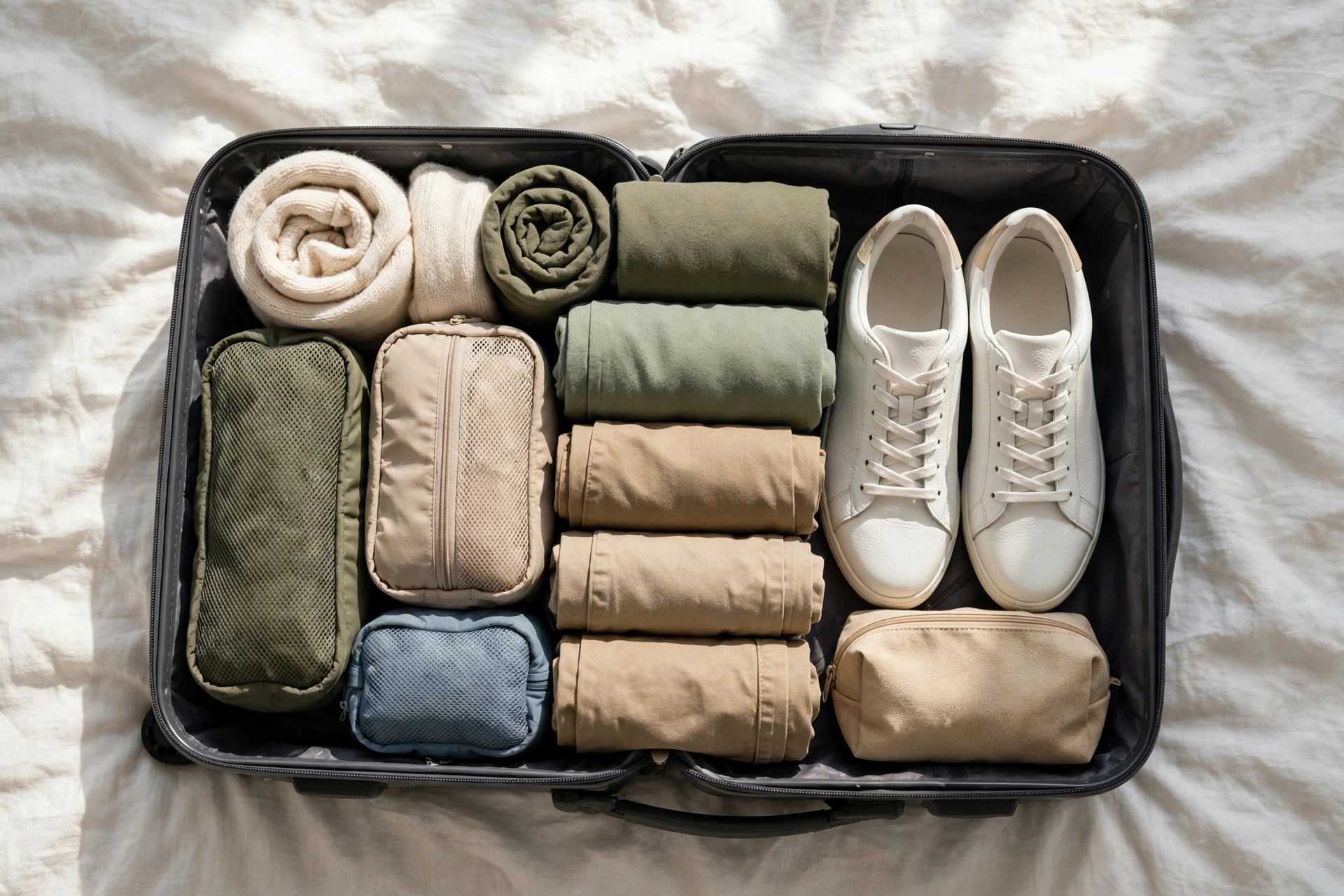
For soft, wrinkle-resistant fabrics — t-shirts, casual shirts, knit tops — rolling genuinely saves space and keeps things compact. For structured items like button-down shirts and trousers, folding along the seams and stacking them flat keeps them looking crisp.
The most efficient approach combines both:
- Roll casual tops, pajamas, underwear, and socks
- Fold blazers, button-downs, and trousers into neat rectangles
- Bundle a delicate garment (a dress or lined jacket) by wrapping it around a core of rolled clothes so it has fewer hard creases
Packing cubes are the real multiplier. They compress soft clothes, group items by type, and — most importantly — keep your bag organized for the whole trip.
Pack in Layers, Heaviest First
Think of the suitcase as a grid. Place the heaviest items — shoes (in bags, soles inward), jeans, and the toiletry kit — at the wheeled end so the weight sits low and the bag balances upright. Folded items go in the middle, and rolled or delicate items on top. and your belt snakes around the perimeter instead of coiling into a lump.
Wear Your Bulkiest Items on the Plane
Your heaviest shoes, your jacket, and your chunkiest sweater never belong in the suitcase. Wear them through the airport. This one habit can free up the equivalent of an entire packing cube — and it doubles as warmth on over-chilled flights. Choose shoes that slip off easily at security and a jacket with deep pockets for your phone, passport, and boarding pass.
Toiletries: The 3-1-1 Rule and the Decanting Habit
On flights with security screening, liquids, gels, and aerosols must follow the 3-1-1 rule: containers of 3.4 ounces (100 milliliters) or less, all inside a single quart-size clear bag, one bag per passenger. Full-size bottles are the fastest way to run out of space.
Decant everything into small travel bottles and pots — shampoo, conditioner, moisturizer, sunscreen. Buy a dedicated travel set once and refill it before every trip. Solid alternatives save even more room: bar soap, shampoo bars, and solid deodorant skip the liquids bag entirely. Keep medications, contacts, and a small first-aid kit in your personal item, never in the checked bag — because with a carry-on-only trip, that means never in the overhead bin where you cannot reach them.
Laundry Is the Secret Weapon
The real answer to the fourteen-day question is washing clothes once mid-trip. Most trips of this length include at least one laundry opportunity:
- Many hotels and Airbnbs have washers; apartment-style stays almost always do
- Local laundromats are cheap and common in most cities
- Hotel laundry services work in a pinch, though they cost more
- A sink wash with travel detergent handles delicates and underwear in minutes — bring a universal sink stopper and a few elastic travel clothesline loops
Pack a small ziplock of travel detergent and one or two laundry bags. Wash on day six or seven, and you only ever need a week of clothes for a month of travel.
Electronics and Your Personal Item
Your carry-on holds the clothes; your personal item (backpack, tote, or laptop bag) holds everything you need within reach: laptop or tablet, chargers, headphones, a book, snacks, and the liquids bag for security. Keep a portable power bank in there too — it is allowed in the cabin but prohibited in checked luggage, so this is one rule where carry-on-only travel has the advantage.
Coil cables with velcro ties and keep adapters in a small pouch.
Common Packing Mistakes to Avoid
- “Just in case” items: the extra jacket, the formal outfit, the third pair of jeans. If it is not on your outfit plan, it stays home.
- Full-size anything: decant, go solid, or buy small at your destination.
- Packing the night before without a list: write your outfit plan down — it takes ten minutes and prevents both overpacking and forgetting essentials.
- Ignoring the return trip: leave a little space for souvenirs, or bring a fold-flat tote that doubles as a spare bag.
Final Thoughts
Packing a carry-on for a two-week trip is not about squeezing harder — it is about needing less. A coordinated capsule wardrobe, one mid-trip wash, your bulkiest layers worn on the plane, and decanted toiletries turn an impossible bag into a comfortable one. The reward is real: no baggage carousel, no lost luggage, no checked-bag fees, and a trip where getting from the airport to your hotel takes minutes. Pack light, and the trip starts the moment you land.
Frequently Asked Questions
Can you really fit two weeks of clothes in a carry-on?
Yes — by packing about a week of versatile, mix-and-match clothing and doing laundry once mid-trip. A capsule wardrobe in two or three coordinating colors makes seven tops and three bottoms feel like far more.
Is rolling clothes better than folding for a carry-on?
For soft casual clothes, rolling saves space and reduces wrinkles. For structured garments like button-down shirts and blazers, flat folding looks better. Most experienced packers use both, plus packing cubes for compression and organization.
What are the TSA liquid rules for carry-on bags?
The 3-1-1 rule applies: liquids, gels, and aerosols in containers of 3.4 oz (100 ml) or less, all inside one quart-size clear resealable bag, one bag per passenger. Medications and baby formula have separate exceptions — check the TSA guidelines for your situation.
Should I bring a personal item too?
Absolutely. Your carry-on goes in the overhead bin; your personal item (backpack or tote) stays at your feet with electronics, documents, snacks, and anything you need during the flight. It effectively doubles your carry capacity.