You come through the old city gate and the street opens onto a medieval square ringed by pastel merchant houses, with a forested mountain rising directly behind the rooftops. That first view explains Brașov in a glance: a Transylvanian city where 600 years of history sit at the foot of the Carpathians. These are the best places to visit in Brasov Romania, from Gothic churches to the castle that launched a thousand vampire novels.
The Old Town and Council Square
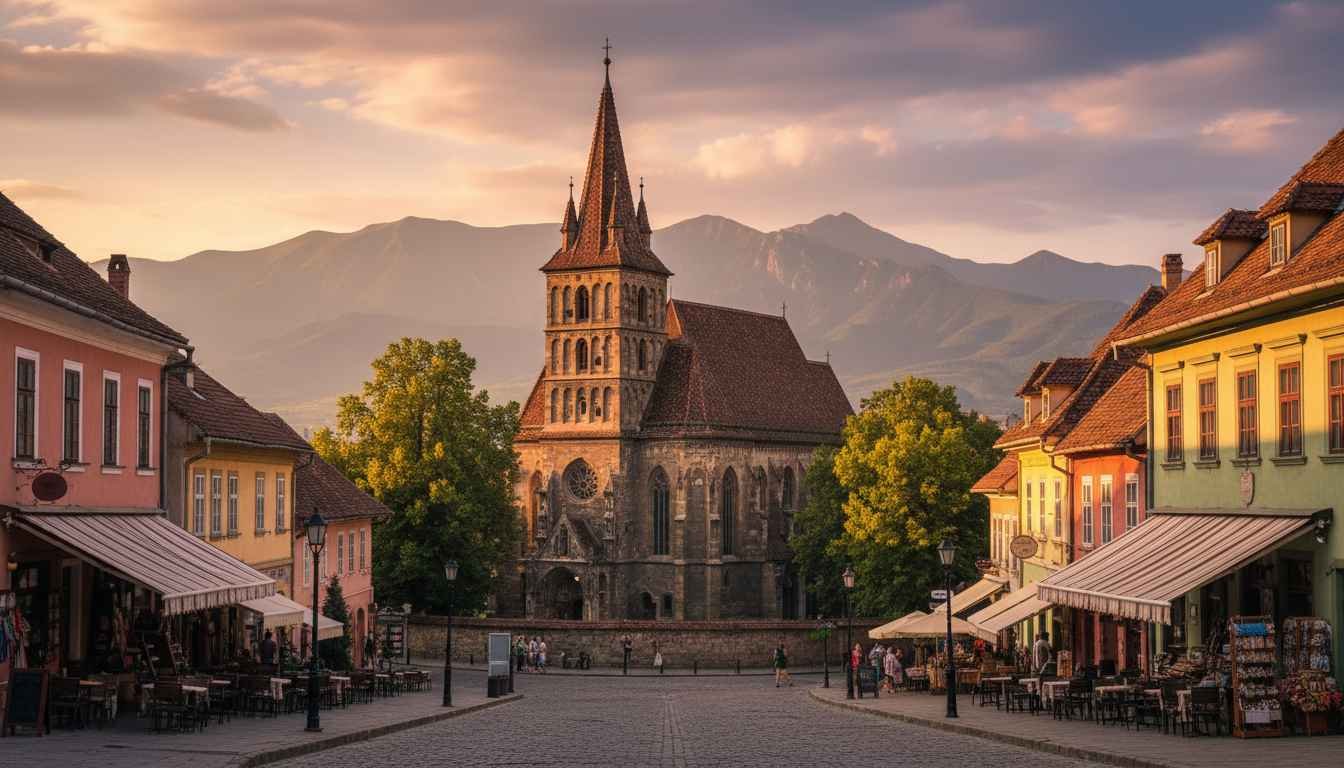
Start in Piața Sfatului (Council Square), the heart of the medieval city. The square’s baroque merchant houses, the old Council House with its trumpet tower, and the fountain at its center make it Brașov’s natural gathering point — by day for coffee on a terrace, by evening for the lit-up facades. From here, wander Strada Sforii (Rope Street), one of Europe’s narrowest streets at barely over a meter wide, and the old city walls with the Black and White Towers still standing guard on the hillside.
The Black Church
Dominating the old town skyline, the Black Church (Biserica Neagră) is Romania’s largest Gothic church and one of the great medieval buildings of Eastern Europe. Built by the city’s Saxon community in the 14th–15th centuries, it earned its name after a 1689 fire blackened its walls. Inside, don’t miss the vast collection of Ottoman carpets — the largest of its kind in Europe — and one of the biggest pipe organs in the region. Check visiting hours before you go, as the church closes to tourists during services and concerts.
Tâmpa: The Mountain Above the City
Rising 400 meters directly above the old town, Tâmpa is Brașov’s natural balcony. A cable car runs from the southeastern edge of the old town to the summit in a few minutes, or you can hike up in about an hour via marked trails. From the top, the whole medieval street plan spreads out below with the Carpathians rolling away in every direction — it’s the single best viewpoint in the city and the perfect orientation for everything you’ll explore on foot afterward. Go on a clear morning for the sharpest views.
Bran Castle: The “Dracula’s Castle”
Thirty kilometers southwest, Bran Castle leans into its legend: marketed worldwide as Dracula’s Castle, its turrets and cliffside position match everyone’s image of the vampire’s lair. The honest history is more nuanced — Vlad the Impaler’s actual connection to the castle is thin and debated, and Bram Stoker never visited Romania. Go for the atmospheric medieval fortress, the royal apartments (Queen Marie made it her residence in the 1920s), and the excellent village museum at its foot — just don’t expect a historically rigorous Dracula story. Buses run regularly from Brașov, or join a half-day tour that pairs it with Râșnov.
Râșnov Fortress and Poiana Brașov
Halfway to Bran, the hilltop Râșnov Fortress offers what Bran can’t: a genuine peasant fortress, built by villagers as a refuge, with panoramic views over the Burzenland. Further into the mountains, Poiana Brașov is Romania’s best-known ski resort — in winter its slopes and après-ski scene draw Bucharest weekenders, while summer brings hiking and mountain biking. Even non-skiers should ride up for the alpine views and a long lunch.
Day Trip: Peleș Castle in Sinaia
If you have a spare day, the train to Sinaia (about an hour) leads to Peleș Castle, the Neo-Renaissance palace of Romania’s first king, Carol I. Its 160 rooms overflow with stained glass, carved wood, and one of Europe’s finest art collections — many visitors rate it above Bran as a pure “wow” experience. Guided tours are mandatory for the interiors and sell out in high season, so book ahead.
Festivals and When to Visit
Brașov hosts the Golden Stag (Cerbul de Aur) international music festival, Romania’s best-known pop festival, alongside medieval festivals that fill the old town with costumed parades in summer. For sightseeing, May through October offers the best weather; December brings Christmas markets to Council Square and the ski season to Poiana Brașov. For the wider country beyond Transylvania, see our guide to tourist attractions across Romania.
FAQ: Visiting Brașov
How many days do you need in Brașov? Two full days covers the old town, Tâmpa, and the Black Church. Add a third for Bran Castle and Râșnov, and a fourth for Peleș Castle or Poiana Brașov.
Is Bran Castle really Dracula’s castle? Not historically — the connection between Vlad the Impaler and Bran is largely marketing built on Stoker’s novel. It’s still a striking medieval castle worth visiting for its own sake.
Can you do Brașov as a day trip from Bucharest? It’s possible (about 2.5–3 hours by train each way) but rushed. Brașov deserves at least one overnight — the old town after dark is half the experience.
Final Thoughts
Brașov works because it layers so well: a walkable medieval core, a mountain you can summit before lunch, and day trips that span Gothic churches to royal palaces. Few European cities of its size offer this much variety within an hour’s radius — which is exactly why it keeps travelers longer than they planned.