
You step off a long-haul flight into bright daylight, but your body is convinced it is the middle of the night. Your eyes sting, your stomach feels unsettled, and the first day of your trip slips away in a fog. That is jet lag: not simple tiredness from flying, but your internal clock still keeping home time while the world around you has moved on. The good news is that you can shorten it, with a little preparation before you leave, smart choices on the plane, and the right light and routine on arrival.
Why Jet Lag Happens
Your body runs on a roughly 24-hour internal clock that controls when you feel sleepy, alert, and hungry, set mainly by daylight. When you cross several time zones in a few hours, the clock does not catch up at once: it stays on home time while meals, daylight, and bedtime at your destination follow a different schedule. The mismatch causes broken sleep, daytime sleepiness, trouble concentrating, and stomach discomfort. The Centers for Disease Control and Prevention describes jet lag as a temporary sleep problem caused by rapid travel across time zones, usually when you cross more than three — see its plain-language guidance on the CDC jet lag page.
The number of time zones you cross matters more than the length of the flight itself: a long flight north to south, staying in roughly the same time zone, rarely causes jet lag at all. Direction matters too — most travelers find flying east harder, because it shortens the day and asks your body to fall asleep earlier than usual. As a rough guide, the body adjusts by about an hour a day, so a six-hour difference can take several days to settle. That is why the best plan starts before you board, not after you land.
Start Before You Leave: Shift Your Sleep Gradually
Begin moving your sleep schedule toward destination time two or three days before departure, shifting by about an hour a day. If you are flying east, go to bed and wake up an hour earlier each day; if you are flying west, go to bed and wake up an hour later. Pair the shift with light: bright mornings when moving earlier, dim evenings. Even a partial shift means your body has less catching up to do on arrival, and your first night at the destination is more likely to be a real night of sleep.
Use those pre-trip days to arrive rested, not exhausted: a late night of packing adds sleep debt on top of jet lag, and the two together feel much worse. Pack the day before and protect a full night of sleep before you fly. If your trip involves an important meeting or event, arrive at least a day early when you can. For a very short trip of only one or two days, stay on home time as far as possible, since your body will not have time to adapt anyway.
Build a Sleep Kit for the Plane
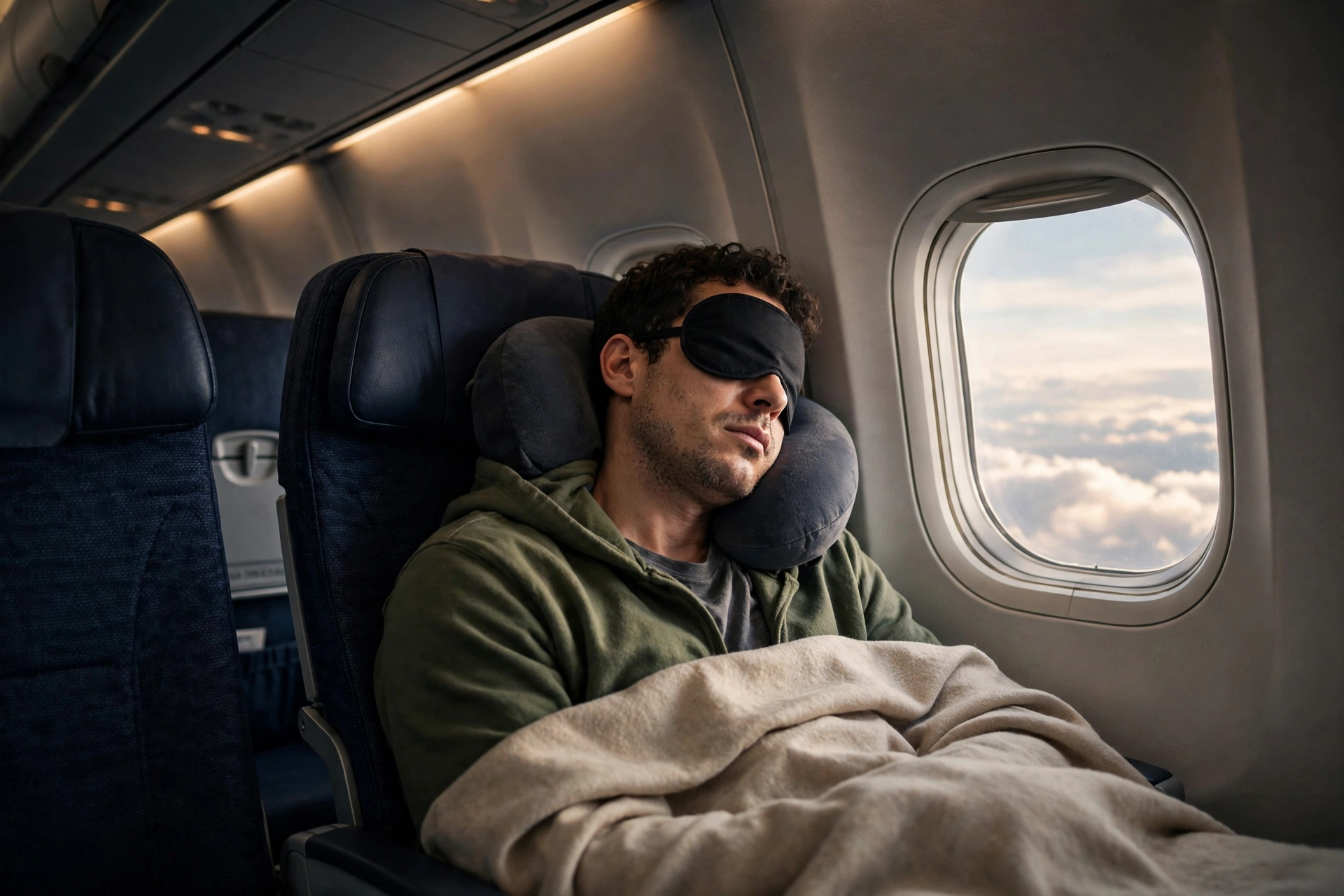
Sleep lost during travel makes jet lag worse, so what you carry on board matters. A simple sleep kit — a contoured eye mask, earplugs or noise-cancelling headphones, a supportive neck pillow, and a light blanket or large scarf — can turn a noisy cabin into something close to a bedroom. Keep it at the top of your bag so you are not digging through overhead luggage when the cabin lights dim. If you travel with only a cabin bag, packing a carry-on for a longer trip around those essentials makes the flight itself far more restful.
Choose your seat with sleep in mind when you can: a window seat gives you a wall to lean on and control over the shade. Whichever you pick, set your watch to destination time as soon as you board and start living by it.
On the Plane: Sleep, Light, Food, and Movement
Time your sleep on board to match the night at your destination. If you land in the morning, sleep during the second half of the flight so you arrive having rested; if you land in the evening, stay awake for most of the flight and sleep after you arrive. When it is sleep time, put the mask on, use earplugs, and skip the movie. When it is daytime at your destination, keep your eyes open, raise the window shade, and stay active. Light is the strongest signal to your internal clock, so use it deliberately.
Eat light and drink water steadily: heavy meals at odd hours can add stomach discomfort to an already unsettled system. Alcohol may make you drowsy, but it breaks up sleep and leaves you groggy, so keep it to a minimum on a flight where you need to rest. Caffeine can help you stay alert during destination daytime, but stop well before destination bedtime. Get up and move every couple of hours — a short walk and a stretch help circulation and stop stiffness from adding to your fatigue.
On Arrival: Get Daylight and Stay Up Until Bedtime
Your first day at the destination sets the pattern for the days that follow, so resist the temptation to nap for hours after checking in. Get outside into daylight as soon as you can, especially in the morning after an eastward flight. Daylight tells your internal clock that the new day has started and helps it shift faster. If you must nap, keep it short — around 20 minutes — and early in the afternoon, so it refreshes you without stealing that night’s sleep.
Stay awake until a reasonable local bedtime, even if that means an early evening. Eat meals on local time, because meal timing is another signal your body uses to reset, and keep your room dark, cool, and quiet. If you sleep lightly, it is worth finding a quiet hotel room for light sleepers when you book, rather than accepting the first room near a lift or a busy road.
Melatonin and Sleep Aids: Talk to a Doctor First
Melatonin is often mentioned for jet lag, because it is a hormone involved in sleep timing, and timed use can help shift the body clock. Taken at the wrong time of day, though, it can push your clock in the wrong direction, and it is sold as a supplement in some countries, so product quality can vary. This guide gives no dosing advice. If you are considering melatonin or any sleep medication, or you take regular medicines or have a sleep disorder, talk to your doctor or a travel health clinic before your trip.
FAQ:
How long does jet lag usually last?
It depends on how many time zones you crossed and in which direction. As a rough guide, expect about a day of adjustment per hour of time difference, with eastward travel usually taking a little longer than westward travel. Good sleep before the flight, daylight on arrival, and a local routine can make the adjustment feel faster, but no trick resets the clock overnight.
Should I sleep on the plane or stay awake?
Follow destination time. Sleep on the plane when it is night at your destination, and stay awake when it is daytime there. Landing in the morning after a night of broken sleep is far harder than landing rested, while sleeping through a flight that lands in the evening can leave you wide awake all night.
Does drinking lots of water prevent jet lag?
Water helps you feel better and avoids the headaches and dryness that come with cabin air, but hydration alone does not reset your internal clock. Think of it as supporting the real tools — sleep timing, light, and meals — rather than replacing them.
Final Thoughts
Jet lag is not a failure of preparation; it is your body keeping time in the place you left. You cannot force it to reset in an hour, but you can give it every advantage: a gentle shift before you leave, real sleep on the plane, daylight and local meals on arrival, and a bedtime you protect. Start early, live on destination time from the moment you board, and stay up through that first long afternoon — and the trip you flew so far to take starts on the first day, not the third.